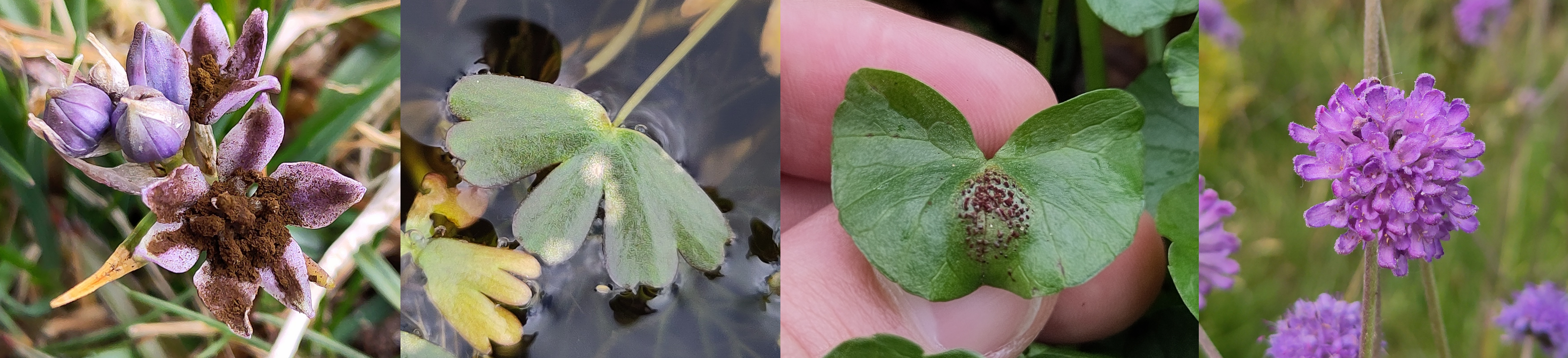
The oömycetes (Oömycota) are a large group of organisms that superficially look like fungi. There are only two groups which you are likely to encounter in the wild: the Albuginales (White Rusts) and the genus Peronospora and its allies (Downy Mildews). There are lots of other groups which I have left out for simplicity, most of which don't infect plants at all or are generalist hemibiotrophs. I have included Phytophthora as it is one that most people will be familiar with, containing Potato Blight P. infestans and Sudden Oak Death P. ramorum.
| Oömycota |
| ||||||||||||
On many species in the Brassicacae. The taxonomy is in flux and on most hosts it is just known as Albugo candida agg./sensu lato.
On many hosts in the Asteraceae. The most common by far is Pustula senecionis on Groundsel Senecio vulgaris, which is extremely common in urban areas.
These can look superficially similar to powdery mildews but are completely unrelated and have quite a different pattern of growth. They grow internally within the leaf. They produce branched conidiophores which grow out of the leaf, usually through stomata on the underside of the leaf. These conidiophores branch into two, and each of these branches branches in two, and so on, bifurcating until it ends in a single conidium (asexual spore). The conidiophores are often quite large and easily visible under a hand lens.
Downy mildews cause infected leaves to yellow and often to curl downwards, something which can be spotted from a distance (a skill to impress your friends with, perhaps!).
The internal growth of downy mildews is often restricted by vascular tissue in the leaf, leading to a distinctive pattern of vein delimitation.
Many species on many different families. This genus also contains the floricolous downy mildews (see below).
Many species, mostly on Orobanchaceae and Apiaceae.
These form sparse to dense conidiophores on Asteraceae.
Sparse to dense conidiophores on the flowers only. Some species alter the development of the flowers, most notably Peronospora violacea. This group is monophyletic and nested within the the genus.
Anecdotally one species P. radii appears to alter the flowering time of its host. In the figure below you can see the infected plant is flowering well before any other in this population of Tripleurospermum. It also appears to at least sometimes cause the host to produce more ray florets than normal, perhaps to increase the surface area conidiophores can form on.