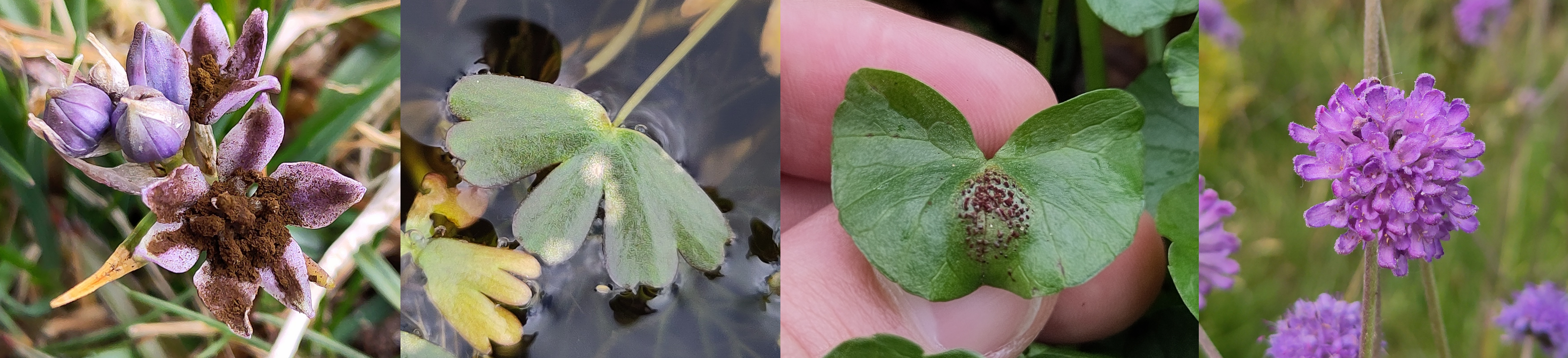
Major groups of Plant Pathogens
The first step to identifying a pathogen is to put it into one of a few major groups. The majority of plant pathogens you will encounter will belong to one of these. They are identifiable without microscopy and after a while you will be able to recognise them without thinking.
Rudimentary key to major groups
I hope this works for most things you find. I am still developing the key so take a look at the list of things that don't key out at the bottom.
- Flowers or leaves?
- Down of small conidiophores visible under hand lens?
- Spores on anthers?
- yes
→ Flower Smuts Microbotryum, Antherospora, Ustilago, Anthracoidea...
- no
→ 4
- Small orange or yellow larvae inside?
- White, purplish grey, or beige down present on leaves? This includes leaf spots with a flat white colour that do not kill leaf tissue.
- Types of down
- Down on leaf spots.
→ 8
- Down not restricted to neat leaf spots (sometimes a difficult distinction).
→ 7
- Structure of down
- Individual conidiophores growing up from leaf surface; white, purplish grey, or beige.
→ Downy Mildews Peronosporaceae
- A web of hyphae growing outwards; generally white or greyish.
→ Powdery Mildews Erysiphaceae
- Structure of conidiophores (note these sometimes need microscopy to distinguish)
- No structure visible under hand lens, flat white.
→ White Leaf Smuts Entyloma
- Conidiophores arranged in small, spikey-looking bunches (caespituli) emerging from a stoma.
→ White Moulds Ramularia, Phacellium
- Round dead spots on leaf?
- Are there orange, beige, or dark pustules or blisters?
- Orange, beige, or dark pustules or blisters
- Dark brown to black, powdery spores emerging from rather large blisters (generally >5mm) in the leaf or stem; spores easily rub off on the fingers.
→ Blister Smuts Urocystis
- Smooth black rounded to linear pustules on the leaves of grasses; no spores visible under hand lens.
→ Phyllachora
- Orange, beige, or dark spores produced in small (<5mm) structures. Individual spores may not be visible under the hand lens.
→ 12
- Rusts vs False Rusts
- Small, wartlike structures with no spores visible under hand lens; colourless or coloured by pigments inside swollen plant cells. The warts have a smooth shiny surface and do not break the surface of the leaf.
→ Chytrids Synchytrium or False Rusts (Note that the spermogonia of true rusts may also key out here; microscopy may be required)
- Spores visible under hand lens.
→ Rusts Pucciniales
- White raised pustules on leaves?
- White rusts vs true rusts
- small (<2mm) white, powdery pustules
→ Rusts Pucciniales
- large white mass; not powdery
→ White Rusts Albuginales
- Larvae inside
- Extra white hair produced on leaves, leaves generally distorted but no obvious larvae present
Stuff that doesn't key out
- Exobasidiales
- Polythrincium trifolii
- Ergots