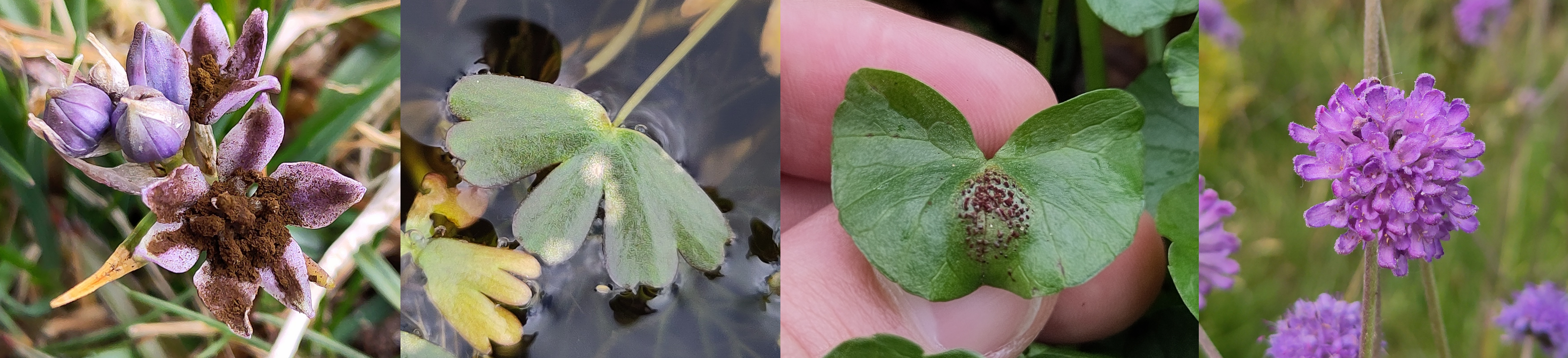
The fungi have a complex and rather confusing taxonomy. For simplicity, let's just consider the main groups relevant to plant pathology.
| Fungi |
| ||||||||||||
The Chytrids (Chytridiomycota) are thought to be sister to almost all other fungi. The pathogen coloquially known as ‘chytrid fungus’ which is devastating amphibian populations worldwide also belongs to this group.
The Ascomycota include the Powdery Mildews, Ergots, and a bunch of less well known groups of pathogens.
The Basidiomycota include the Smuts, Rusts, and Exobasidiales. They also include the Agaricus mushrooms you buy in the shop.
Leaf spot fungi have evolved many times. They include White Moulds, and many other groups that I have put under Other Leaf Spots.
The genus Synchytrium (False Rusts) forms warty pustules on many different hosts. These can be colourless, orange, red, or brown. They produce zoöspores which infect further parts of the plant by swimming through films of water. Synchytrium is the only group of chytrids which is a major pathogen of plants.
They are usually inconspicuous and as a result most are likely very underrecorded. The only species which is commonly recorded in Ireland is Synchytrium taraxaci.
Powdery mildews are very common in most habitats. They are highly diverse and most are host-specific, but without microscopy they mostly look quite similar. Often they can be distinguished by host alone, as many hosts have only one known powdery mildew.
Powdery mildews have a distinctive pattern of growth: they have external mycelium which forms a web-like pattern on the surface of the leaf. This is usually white and powdery looking. It is often on the upper side of the leaf. Microscopic white conidiophores are formed within this mycelium which produce asexual spores dispersed by wind.
Sometimes powdery mildews form sexual spherical black or dark brown fruiting bodies known as chasmothecia. On some hosts microscopic features of the chasmothecium are useful for identification.
Ergots form dark brown to black sclerotia in the flowers of grasses and Eleocharis. They all look quite similar, but several different species can be distinguished. The important characters are the host and whether the sclerotia float or sink when placed in water for 2 hours or longer1,2.
Smuts are a polyphyletic group. This means the smut lifestyle has evolved independently several times, so when we consider the smuts as a group we are considering several different branches of the tree of life. What unites them is producing large numbers of teliospores on the plants they parasitise[source?].
Smut fungi can be divided roughly into flower smuts and leaf smuts.
| Basidiomycota |
| |||||||||||||||||||||||||||||||||||||||||||||||||||||||||
Flower smuts classically produce large numbers of teliospores in the anthers of their hosts, replacing the pollen. There are also a number of species which produce teliospores in the ovaries of their hosts, like Urocystis primulae and Tilletia spp. These species generally produce conidia in the anthers of the flower as well.
Most Urocystis species form spores in the leaves and are under Blister Smuts.
Note not all Ustilago species are flower smuts — some, like Ustilago perennans, form spores in the leaves, so I have put them under Blister Smuts.
These form dark brown powdery blisters on the leaves of plants. There seem to be a lot of species on grasses and sedges, and in these hosts they follow the direction of the veins, forming long brown lines that split open like zips along the length of the leaf.
Urocystis smuts form “spore balls” within the leaves of their hosts, which rest in the soil. These later germinate to produce basidiospores that go on to infect new host plants (see figure below).
Ustilago blister smuts produce simple, single-celled spores in the leaves of their hosts.
Rusts are a widespread, common, and iconic group of plant pathogens. Many of them have complex lifecycles with multiple stages on different hosts.
Rusts form orange, brown, yellow, or rarely white pustules usually on the leaves of their hosts. Their spores are usually visible as a fine powder under the hand lens.
Rusts have up to five different stages in their life cycle, sometimes across two different host plants. Three are obvious and commonly seen:
These are the ‘typical’ rusts that are often the most conspicuous.
Very variable in form.
Small warty orange uredinia on many different herbaceous and shrubby hosts. They also form telia but these are minute. At least some have an aecial stage on trees.
White uredinia on ferns. They often look like a dusty or dirty residue on the underside of the fronds, sometimes causing brown dead patches as well.
White moulds generally produce conidiophores on necrotic leaf spots on the underside of the leaf. They are arranged in spiky clusters (caespituli). These are sometimes bunched together to form columnar synnemata, especially in the genus Phacellium.
To the naked eye these structures can look similar to downy mildews but they are much smaller and are rarely vein-delimited. Under a hand lens they have a much messier appearance than the elegantly bifurcating conidiophores of downy mildews.
Many different groups of fungi form leaf spots with structures like pycnidia producing spores within the leaf. The most important of these is Septoria, which is diverse and common. Many host plants have multiple leaf spot fungi which can only be distinguished by measuring their spores. It isn't uncommon for one host plant to have two species of Septoria.
Leaf spots can be difficult to spot and study. It can sometimes be worth looking at what looks like just a ‘dead patch’ under the hand lens to see if fruiting structures are visible.
Septoria is the genus of leaf spots you will encounter most frequently. They are anamorphs, meaning they are the asexual stages of fungi that generally also have a sexual stage, but in most cases the sexual stage isn't known. They produce asexual spores called conidia in pycnidia embedded in dead leaf spots. The conidia of Septoria are long and colourless, and can have zero to many septa — walls dividing the conidium into multiple cells. They are spread between plants by splashing rain3.
